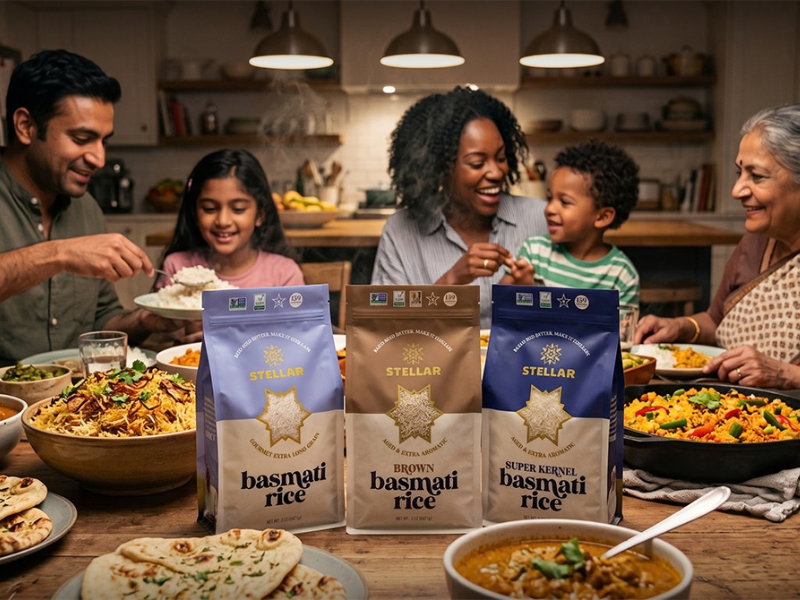
A lot of basmati brands will tell you their rice is special. Most of them are working from the same field. What actually separates one bag from another comes down to three things: where the rice was grown, how long it was left alone after harvest, and who grew it. Our answer to all three is more specific than most brands bother to be.
Where it’s grown
We grow in the Kaalar Belt, a stretch of Punjab, Pakistan, between the Ravi and Chenab rivers, fed by meltwater running down from the Himalayas. It’s the same ground basmati has grown in for generations, and the same ground where Basmati 370, the variety at the root of nearly every basmati grown today, was first identified in 1933. Grow the same seed somewhere else and you get a longer or shorter grain, a fainter aroma, something that’s basmati in name only. The soil and water here aren’t a backstory to us. They’re the reason our rice tastes the way it does.
Why it’s aged a full year
After harvest, we let our rice sit for a year before we sell it. That’s slower than it needs to be. Rice can be aged faster with heat or chemical treatments that mimic the effect, and a lot of brands do exactly that. We don’t. A full year of natural aging lets the grain lose moisture on its own terms, which is what makes it cook up firmer, separate, and more fragrant than rice sold fresh off the harvest. It’s a longer wait for a better result, and there’s no way to shortcut it without it showing up in the pot.
Who grows it
We work with more than 600 farm families near our mill, paid directly, without the usual middlemen taking a cut along the way. We were also the first consumer basmati brand to put the Sustainable Rice Platform‘s logo on our packaging, a group of more than 100 organizations working toward better rice farming worldwide. None of that is charity. Farmers who are paid fairly and supported with better seed and training grow a better crop, year after year, and that shows up in our bag.
Farmed with newer tools, too
Our fields also run on more than tradition. As part of our regenerative farming program, targeted drones deliver treatments directly to the plants that need them, in the amount they need, instead of blanketing a field the way growers have for decades. We don’t flood our fields, either, which cuts down on both water use and the methane that flooded paddies produce. After harvest, we don’t burn the leftover rice straw, a practice that’s a major source of the region’s smog each fall; it gets ploughed back into the soil to replenish it with natural nutrients. None of that shows up in the bag directly, but it’s the same instinct that shapes everything else we do: do it the way that actually works, even when the industry default is easier.
What it’s good for
That combination, region, age, and how we farm, is why our rice holds up in a plain weeknight side dish and doesn’t fall apart in something more involved, like a vegetable biryani or a jambalaya. We’ve seen it turn up just as well in dishes basmati was never meant for, like Italian arancini, which says more about the rice than any one recipe can. Cooking times vary a bit by pot and stove, so trust your senses over a stopwatch: look for grains that separate cleanly, a fragrance that fills the kitchen, and a bite with some structure left in it. Find us near you and judge for yourself.
FAQ
What makes Stellar different from other basmati brands? Where we grow it (the Kaalar Belt in Pakistan), how long we age it (a full year, the traditional way), and who grows it (over 600 farm families we pay directly).
How long is Stellar basmati aged? A full year. We use traditional aging rather than heat or chemical shortcuts.
Is Stellar basmati sustainably grown? We were the first consumer basmati brand to carry the Sustainable Rice Platform’s logo on our packaging. SRP is an alliance of more than 100 organizations working on sustainable rice farming.
Does Stellar use technology to farm more sustainably? Yes. We use targeted drones to deliver treatments directly to plants, avoid flooding our fields to cut water use and methane, and repurpose post-harvest straw as fodder instead of burning it.