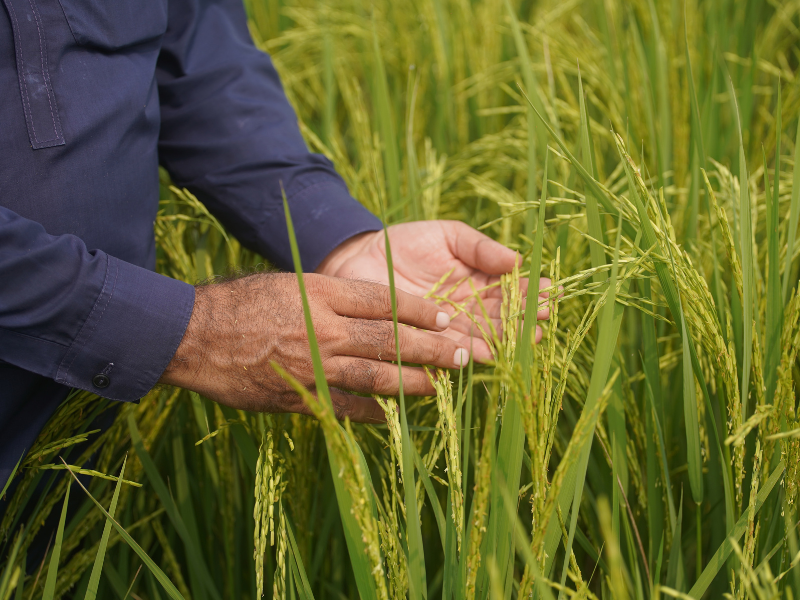
Basmati rice comes from Punjab, in the foothills of the Himalayas. One of its traditional growing areas is the Kaalar Belt in Pakistan (also spelled Kalar or Kallar), a stretch of land between the Ravi and Chenab rivers. Nobody is quite sure where that name comes from. One theory points to salt in the soil, another to the way the two rivers curl around the land like a collar. Punjab is split by a border these days, and basmati grows on both sides of it. We’re making the case for ours.
What is the earliest written record of basmati?
The earliest mention anyone has found is in Heer Ranjha, the Punjabi love story Waris Shah wrote in 1766. Waris Shah came from what is now Pakistani Punjab, and the story is set in Jhang, on the Chenab. A wedding scene lists the rice on offer, basmati among them. One agricultural scientist noted that a rice doesn’t get named in a poem until it has been well known for decades, which puts basmati’s beginnings well before 1766.
The name points to aroma: its first half means fragrance, and sources disagree on the rest. Mughal emperors prized that aroma and the slender grain, and the Ain-i-Akbari, Akbar’s imperial record, notes a red-husked relative of basmati grown in the provinces of Lahore and Multan (both in today’s Pakistan), among others.
What is Basmati 370?
The scientist Sardar Mohammed Khan led the early breeding program and personally travelled on horseback and collected and classified the locally grown rice types. One selection collected from a place called Kaulo Tarar (Tarar is also the family name of the owners of Stellar) became Basmati 370. In 1933, the Rice Research Farm at Kala Shah Kaku, set up in 1926 and now the Rice Research Institute, released Basmati 370, the first pure-line basmati variety. Farmers had been growing basmati for centuries by then. “Pure-line” means the plants breed true, so seed saved from one crop gives you the same rice next season. In Pakistan, Basmati 370 became the parent of almost every basmati variety released afterward.
Why does basmati from this region taste the way it does?
Basmati’s historic home is the Kallar belt of Punjab, where fertile alluvial soils, the glacial meltwater from the Himalayas and a distinctive growing season come together. Traditional basmati varieties are sensitive to day length: as the days shorten after summer, they begin to flower, so their grains fill and mature in autumn’s warm days and cooler nights. These milder conditions help the developing rice build and retain the natural compounds behind its delicate aroma, while supporting the slender grains and lengthwise elongation that make basmati light and fluffy when cooked. Variety, farming and careful handling matter too, but this meeting of land, water and season helps explain why the region has been celebrated for basmati for generations.
Pakistani rice researchers write that traditional basmati quality can only be achieved in the traditional growing area. Pakistan registered its own geographical indication for basmati in 2021.
Who grows Stellar basmati?
Usman Dilshad and Younas Gujjar, from Eminabad, are among the 600-plus farm families who grow rice for Stellar, backed by agronomists, certified seed and a buyback guarantee. Their rice goes to Galaxy Rice Mill, a family-owned mill with more than 20 years behind it, where it’s aged for a full year the traditional way, with no artificial shortcuts, so the aroma has time to develop.
We’re biased, obviously. But the earliest written mention, the first pure-line variety, the meltwater and a year of patience all point at the same stretch of Punjab. It’s hard to argue we picked the wrong spot.
What to expect when you cook it
Every stovetop cooks a little differently, and rice is variable enough that we’d rather not hand you a rigid formula. What you’re after is grains that separate instead of clumping, a fragrance that fills the kitchen before you even lift the lid, and a bite with a little structure left in it. Start with the guidance on each bag of Stellar and adjust from there. It holds up as well in a vegetable biryani as it does somewhere you might not expect, like Italian arancini and Cajun jambalaya. Explore more in the Culinary Hub, or find Stellar near you and see for yourself.
FAQ
Where does basmati rice come from? Punjab, in the Himalayan foothills, across parts of present-day Pakistan and India. Its traditional growing area in Pakistan is the Kaalar Belt, between the Ravi and Chenab rivers.
What does basmati mean? The first half of the name means aroma or fragrance, and sources disagree on the second half.
What is Basmati 370? The first pure-line basmati variety, released in 1933 by the Rice Research Farm at Kala Shah Kaku. It became the parent of nearly all basmati varieties Pakistan released afterward.
What is aged basmati? Basmati stored after harvest so the grain dries and its aroma deepens. Stellar ages its basmati for a full year, using the traditional method.